
Images from the air we breathe.
At Xemed we build instruments that polarize noble gases. Polarized xenon-129 is used for magnetic resonance imaging of the lungs. Polarized helium-3 is used in neutron science and nuclear physics, and is planned for fusion energy research.
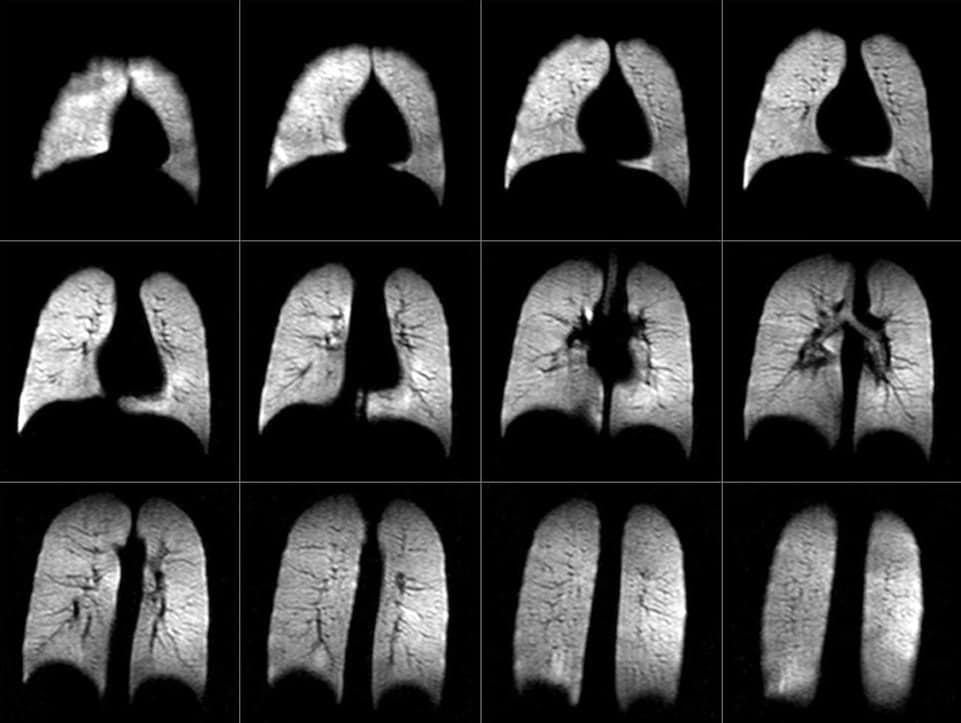
At thermal equilibrium, the nuclear spins of a gas are almost randomly oriented. The gas gives almost no signal in an MRI scanner. Hyperpolarization uses laser light to align the nuclear spins of a noble gas. This increases the nuclear magnetization about a hundred thousand times. We have more than two decades of experience in polarizing gas in large quantities. We work with two gases that behave very differently.
Xenon-129
A laser polarizes rubidium atoms, and collisions pass that polarization to the xenon nuclei. For xenon this transfer takes seconds, and it is fastest at low pressure. Our polarizer is therefore a column over five feet long, with the gas flowing toward the laser. It has been fully automated since 2010, and it operates at clinical research sites. The patient inhales one or more breaths of the polarized xenon. The scanner then shows where the gas went in the lungs, and how much of it passed into the blood.
Helium-3
Helium takes hours to polarize. It must be held at high pressure in a glass cell. Our polarizer uses a thin-walled glass cell inside a pressure vessel. The cell is in contact with a thermal reservoir. It is tilted, so that gravity keeps the gas circulating. The polarizer has reached a polarization of around 85% in a two-liter cell. We are installing the first one at a customer’s laboratory.
Xenon-129
- Since 2010
- fully automated
- 40 to 50%
- xenon-129 polarization, measured in the bag
- 4 to 6 liters
- of polarized xenon per hour
Helium-3
- Around 85%
- helium-3 polarization, in a two-liter cell
- About 5 hours
- spin-up time of the best run
- Up to 70 hours
- longitudinal relaxation time (T1) of a two-liter cell
The xenon polarizer
Why our xenon polarizer is a long column with flowing gas, and what it delivers.
Helium-3
A thin-walled glass cell inside a pressure vessel. The cell is tilted so that gravity keeps the gas circulating.
Lung imaging
Ventilation imaging, gas-exchange imaging, the clinical studies to date, and our current direction.
Products
Xenon and helium-3 polarizers, enriched xenon-129, and support for investigators.